Fur Mom Hand Lettering SVG Cutting File
A Designer’s First Glance: Warm, Worn-In, and Immediately Relatable
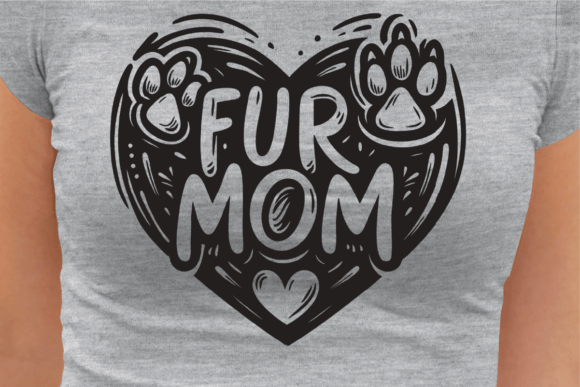
When I opened Fur Mom Hand Lettering SVG Cutting File, what struck me first wasn’t technical precision—it was tone. This isn’t a stiff, over-polished script or a trendy sans-serif slapped onto a pet theme. It’s loose, slightly uneven hand lettering with gentle swells and soft terminals—like something you’d see inked on a coffee mug at a local dog park or stitched onto a linen apron in a cottage-core kitchen. The “Fur Mom” phrase sits comfortably as one visual unit, not two disconnected words. That cohesion matters. It tells me this design was built for readability at small-to-mid scales—not just as a digital graphic, but as a machine embroidery design that needs to hold up when translated into thread.
Real Project Test: Embroidering a Linen Tote Bag for a Local Pet Rescue Pop-Up
Last week, I prepped a batch of custom linen tote bags for a weekend fundraiser hosted by a no-kill shelter. We needed something heartfelt but not cutesy—something that felt handmade, not mass-produced. I chose Fur Mom Hand Lettering SVG Cutting File for the front panel, centered just below the handle seam. Why? Because its organic rhythm softened the stiffness of the natural linen texture, and its moderate height (roughly 3.5" wide at standard scaling) gave us breathing room without sacrificing impact. On the tote, it read clearly from six feet away—but more importantly, it invited touch. People paused, smiled, and said things like, “That’s *exactly* how I sign my birthday cards.” That kind of quiet resonance is gold for a personalized gift or small shop product.
Where It Shines—and Where It Needs Thoughtful Handling
This design excels on stable, medium-weight fabrics: cotton twill for aprons, midweight fleece for sweatshirt embroidery, brushed poly-cotton for baby embroidery, and even tea towels where stitch definition stays crisp. As a tote bag design or pillow cover motif, its open letterforms allow fill stitch to breathe—no dense, muddy areas that trap lint or distort fabric. It also translates well into an embroidered patch when backed with lightweight fusible web and finished with satin stitch borders.
But—and this is where experience kicks in—don’t rush it onto stretchy knits or thin voile without testing. The lowercase “u” and “r” have subtle curves that can blur if stabilizer shifts during hooping. On dark fabric, avoid light pastel threads unless you’re willing to add underlay; the hand-lettering style relies on clean edge contrast. And skip curved surfaces like caps unless you’re using a cap frame and have confirmed the design’s width fits comfortably within your hoop’s usable area. Tiny corners—especially where the “M” foot meets the baseline—can snag if stitch density runs too high or thread tension isn’t dialed in.
What It Adds to Your Finished Product (Beyond the Obvious)
Fur Mom Hand Lettering SVG Cutting File doesn’t just say “I love my pet.” It says, “This was chosen with care.” That nuance lifts perceived value. Customers notice the difference between a generic font and intentional hand-drawn rhythm—it signals authenticity, which builds trust for Etsy sellers and craft business owners alike. When used on nursery decor or holiday embroidery (think: embroidered onesies for a “Fur Mom & Baby” gift set), it feels cohesive and warm—not forced or commercial. It also supports brand consistency: pair it with simple line-art paw prints or minimalist bone motifs, and you’ve got a quiet, ownable aesthetic for boutique branding or printable mockups.
Practical Notes Every Embroidery Designer Should Run Through
- Always test first: Stitch Fur Mom Hand Lettering SVG Cutting File on scrap fabric matching your final project’s weight and stretch—even if it’s “just a t-shirt.” Linen, cotton poplin, and fleece all behave differently under needle and thread.
- Check thread color contrast: Try black thread on cream fabric *and* cream thread on navy. Hand-lettering relies on silhouette clarity—low-contrast combos can mute its charm.
- Review stitch density: If your version includes heavy fill stitches in the letter bodies, consider simplifying to a lighter fill or adding running stitch outlines for definition on textured surfaces.
- Confirm hoop size and placement: Measure the design’s widest point before hooping. Leave at least ½" margin around all edges—especially important for custom apparel where seams or pockets might interfere.
- Inspect small details: Zoom in on the “o” counter and the crossbar of the “F.” Are they open enough to stitch cleanly on your machine? If not, a quick digitizing tweak may be needed.
- Verify licensing: Since this is listed as a Graphics file in the T-Shirt Designs category, confirm whether it’s cleared for commercial embroidery use—especially if you plan to sell finished products or bundle it into digital embroidery kits.
Final Thought: A Quiet Workhorse, Not a Flashy Gimmick
Fur Mom Hand Lettering SVG Cutting File won’t shout. It doesn’t need to. Its strength is in reliability, warmth, and quiet intention—qualities that serve handmade product makers better than any trending effect. It’s the kind of digital embroidery file you keep in your “go-to” folder: not because it’s flashy, but because it consistently delivers emotional resonance, clean stitching, and real-world versatility—from baby embroidery to boutique merchandise, from holiday embroidery to everyday custom apparel. Just remember: great design starts with thoughtful execution. Test it. Tune it. Trust your eye—and your machine.