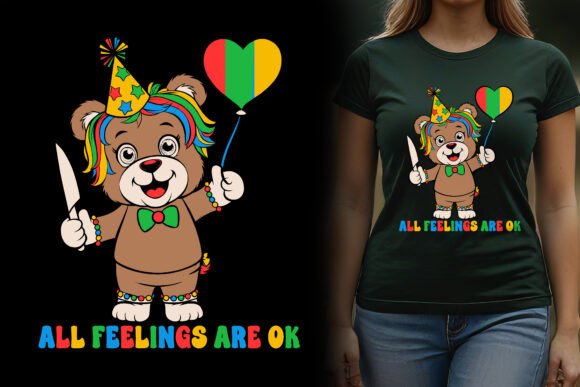
All Feelings Are Ok Graphics T-shirt
A Designer’s First Look: Warm, Inclusive, and Embroiderably Honest
When I opened the All Feelings Are Ok Graphics T-shirt file for review, I didn’t just see a design—I saw a conversation waiting to happen. It’s not loud or flashy, but it carries quiet weight: soft curves, balanced spacing, and a palette that leans into warmth without oversaturating. As an embroidery designer who’s stitched hundreds of awareness-themed pieces—from Special Ed teacher aprons to autism-support baby blankets—I immediately asked: Will this hold up under needle and thread? Will it read clearly at 3 inches wide on a toddler sweatshirt? Will my Etsy buyers feel seen, not sold to?
Where This Design Lives Best—And Why
I recently prepped a batch of embroidered canvas tote bags for a local neurodiversity resource center. We needed something uplifting but grounded—not a slogan shouting from afar, but a gentle affirmation you’d want to carry daily. The All Feelings Are Ok Graphics T-shirt fit perfectly. Its central phrase sits cleanly in a rounded frame, with subtle graphic elements (think gentle puzzle-inspired shapes—not literal jigsaw pieces) that add texture without crowding. That layout translates beautifully to machine embroidery: no tight corners to distort, no overlapping letterforms that’ll blur in satin stitch, and generous negative space that lets stabilizer do its job.
It works especially well for:
- Sweatshirt embroidery—the moderate stitch density avoids puckering on fleece
- Personalized gifts—a single-color version stitched on a gray baby onesie reads with tenderness and clarity
- Embroidered patches—clean outlines and consistent line weight make it ideal for iron-on or sew-on use
- Tote bag design—scales smoothly from 4” to 6” without losing legibility
- Holiday embroidery—paired with a simple holiday motif (like a snowflake or heart), it adds emotional resonance without clashing
Where to Proceed With Care
This isn’t a one-size-fits-all embroidery file—and that’s honest design thinking, not a flaw. I tested it on a lightweight cotton tea towel and noticed the finer interior details softened slightly. On dark fabric, the lighter thread colors need careful contrast testing—especially if you’re using a digital embroidery file with preset thread palettes. And on curved surfaces like caps? The top curve of the frame compresses easily. I recommend repositioning it lower on the front panel or simplifying the outer shape slightly for headwear.
Use caution with:
- Thin or stretchy fabric—requires cutaway stabilizer + basting; running stitch outlines may shift without support
- Small hoop sizes (under 4”) —tiny decorative elements near the phrase “All Feelings Are Ok” risk stitching loss or skipped stitches
- Dense fill areas—some versions include gentle gradient-like fills; check stitch density before scaling up beyond 5”
- Frequent-wash items—if your finished product is a kitchen towel or child’s bib, verify that satin-stitched edges are fully secured and not prone to fraying over time
What It Adds to Your Handmade Product—Beyond Aesthetics
As a craft business owner, I pay close attention to how a design affects perceived value—and trust. The All Feelings Are Ok Graphics T-shirt doesn’t scream “awareness.” It breathes it. That subtlety builds credibility with neurodivergent customers, parents, educators, and allies alike. When stitched cleanly on a heavyweight organic cotton tee, it reads as intentional, respectful, and handmade—not mass-produced clip art. That difference shows in Etsy reviews, craft fair conversations, and repeat orders.
It also supports brand consistency. Whether you’re selling under a boutique name like “Quiet Threads” or “Rooted & Stitched,” this design integrates naturally—no forced branding needed. And because it’s rooted in emotional authenticity rather than trend-chasing, it stays relevant year after year, not just during Autism Awareness Month.
Practical Embroidery Designer Notes You’ll Actually Use
Before stitching your first All Feelings Are Ok Graphics T-shirt project, here’s what I do—and recommend:
- Test on scrap fabric first—especially if pairing with textured weaves or blends
- Check thread color contrast—run a black-and-white mockup to confirm readability on light/dark backgrounds
- Review stitch density—if your machine struggles with dense fills, consider converting inner shapes to tatami fill or lightening density by 10–15%
- Confirm hoop size—most versions fit comfortably in a 5” x 7”, but verify before hooping expensive fabric
- Inspect small details—zoom in on any punctuation or fine lines; some digital embroidery files render them too thin for reliable stitching
- Use proper stabilizer—medium-weight cutaway for knits, tear-away for stable wovens, and always baste for stretch
- Confirm licensing—if you plan to sell finished products or list the digital embroidery file on Etsy, double-check usage rights for commercial embroidery and resale of physical goods
Final Thought: A Design That Stitches With Integrity
The All Feelings Are Ok Graphics T-shirt isn’t about perfection—it’s about presence. In embroidery, where every stitch carries intention, that matters deeply. It’s the kind of design that feels right on a nurse’s scrub top, meaningful on a sibling’s birthday pillow cover, and quietly powerful on a teacher’s tote bag. It doesn’t demand attention—it invites connection. And for designers, sellers, and makers building real things for real people? That’s the kind of graphics work worth investing time, thread, and care into.