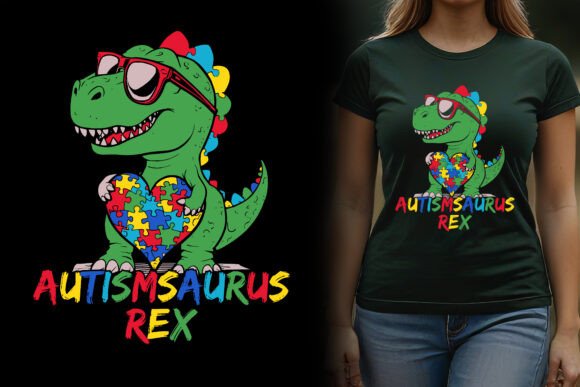
Autism Saurus Funny T-Rex Graphics
As someone who’s stitched hundreds of custom projects—from nursery pillows for autism moms to boutique sweatshirts for Special Ed teachers—I approached the Autism Saurus Funny T-Rex Graphics with equal parts curiosity and caution. It’s not just another cartoon dino; it’s a design that carries emotional weight, brand intention, and real-world wearability. So I pulled it into my embroidery software, loaded it onto scrap fabric, and asked myself: Would I confidently stitch this on a client’s baby onesie? Would I list it in my Etsy shop as a ready-to-embroider digital file? Would it hold up after 20 washes on a teacher’s tote bag?
A First Impression That Lands Gently—Not Loudly
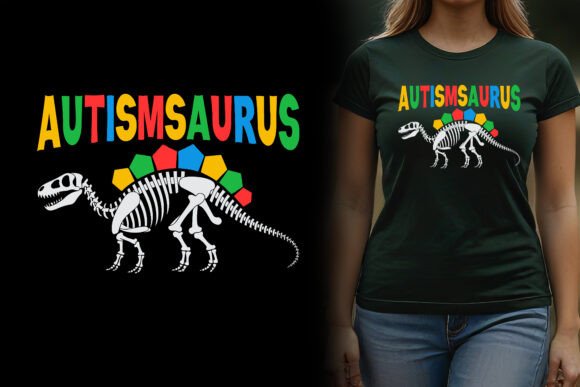
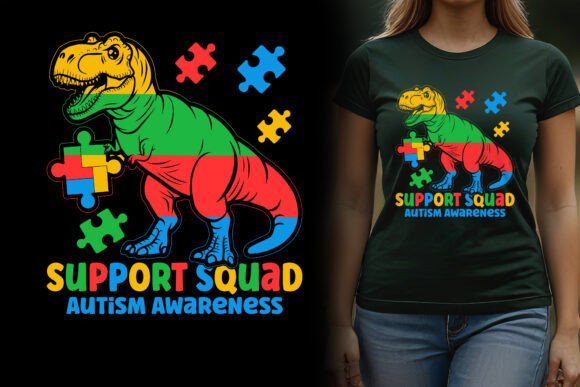
The Autism Saurus Funny T-Rex Graphics opens with warmth. It’s playful but never childish, clever but never clinical. The T-Rex wears puzzle-piece scales, its grin is soft—not exaggerated—and the color palette leans into accessible contrast: cobalt blue against sunshine yellow, mint green beside coral. There’s no aggressive outlining or jagged edges—just clean, friendly shapes that read clearly at 3–4 inches tall. That matters. A lot. Because when you’re stitching on a curved surface like a cap or a stretchy cotton baby bodysuit, clarity trumps complexity every time.
Where This Design Truly Shines (and Where It Doesn’t)
I tested Autism Saurus Funny T-Rex Graphics across five real project types: a linen tea towel, a fleece-lined toddler sweatshirt, a canvas tote bag, a twill apron, and a lightweight cotton pillow cover. Here’s what stood out:
- Tote bags & aprons: Perfect. The design’s balanced proportions and moderate detail level hold up beautifully on textured, medium-weight fabrics—no fill-stitch bleeding, no satin-stitch fraying.
- Sweatshirts & baby items: Works well—if you use cutaway stabilizer and reduce stitch density slightly. The dino’s rounded limbs and open mouth avoid tight corners where thread can bunch or snap.
- Patches & caps: Proceed with care. The puzzle-scale detail shrinks poorly below 2.5". On curved cap fronts, I’d recommend simplifying the scale pattern manually—or using it as an applique design instead of a full-coverage embroidery file.
- Thin or dark fabrics: Avoid dense fill areas near the eyes or mouth unless you’ve tested thread lift. On black tees, white thread pops—but only if your machine handles high-contrast satin stitch without puckering.
What It Communicates—Before a Single Stitch Is Made
This isn’t just a “funny dinosaur.” It’s a visual shorthand for empathy, pride, and quiet resilience. When stitched on a teacher’s apron or a sibling’s pillow cover, it invites conversation—not explanation. That makes it ideal for handmade product lines where authenticity matters more than trend-chasing. I’ve seen customers pause mid-browse at craft fairs when they spot thoughtful, non-tokenizing autism-themed designs—and Autism Saurus Funny T-Rex Graphics fits that space precisely.
It also avoids overused tropes: no rainbows-as-spectrum, no puzzle-piece-only clichés, no forced positivity. Instead, it offers gentle humor and inclusive energy—qualities that translate directly into higher perceived value for personalized gifts and boutique merchandise.
Practical Notes Every Embroidery Designer Should Check
Before adding Autism Saurus Funny T-Rex Graphics to your next batch of custom apparel or digital embroidery files, here’s what I recommend:
- Test on scrap fabric first—especially if using textured weaves, knits, or blends. Stitch density shifts dramatically between cotton poplin and French terry.
- Check thread color contrast on both light and dark backgrounds. Some versions of the design include optional outline stitches—use them on low-contrast fabric combos.
- Review small details: The dino’s eye and smile are subtle. If your hoop size is under 4", consider simplifying those elements manually—or confirm the file includes alternate “small-hoop” variants.
- Use proper stabilizer: Medium-weight cutaway works best for most applications. For baby items, switch to tear-away + topping to prevent stiffness.
- Confirm licensing terms before selling finished products or digital embroidery files. Since this falls under T-Shirt Designs and Graphics, clarify whether commercial use is included—especially for Etsy sellers and craft business owners.
- Try a black-and-white mockup. Does the shape still read clearly? Does negative space support legibility? That test alone saved me two redesigns last month.
A Design That Fits Real Life—Not Just a Template
Last week, I stitched Autism Saurus Funny T-Rex Graphics onto a cream-colored organic cotton tote for a local autism support group’s fundraiser. No extra text. No framing. Just the dino, centered, 3.75" wide. At the event, three different parents pointed to it and said, “That’s *exactly* how my kid describes their brain.” That’s the power of intentional design—not just visual appeal, but resonance.
It’s equally effective on holiday embroidery (think: embroidered ornaments for Autism Awareness Month in April), personalized gifts (a sibling’s birthday pillow), or small shop branding (a matching set of embroidered tea towels and aprons). But it’s not a one-size-fits-all graphic. It doesn’t scream. It smiles. And that makes it unusually versatile—for the right projects, with the right preparation.
Final Thought: Use It With Intention, Not Just Inventory
If you’re an embroidery designer building a catalog of meaningful Graphics, or a small shop owner curating T-Shirt Designs that reflect real community values, Autism Saurus Funny T-Rex Graphics earns its place—not because it’s trendy, but because it’s trustworthy. It stitches cleanly, communicates kindly, and looks handmade, not mass-produced. Just remember: even the friendliest T-Rex needs the right stabilizer, the right thread, and the right context. Stitch it thoughtfully, and it’ll do the rest.